VEdition Documentation
⚠️ This documentation is work in progress and is undergoing refactoring!
Welcome to the VEdition technical documentation. Currently, these pages are mostly targeted to internal use, and provide the theorical foundation of the model and some instructions about using its software.
VEdition will provide a new digital edition of Goethe’s Venetian epigrams (here GVE for short). Given the highly peculiar nature of this text, this digital-born project also aims to propose a new digital model and software tools for authorial philology applied to similar scenarios.
So, beyond the central case study provided by VEdition, GVE in Digital Humanities proposes:
- a new digital model for a dynamic, compact and transformative representation of text, both on textual and visual layers.
- a full-stack open source software solution to create edition data using this model, highly customizable and modular so that it can be easily tailored to each specific project.
Source Code
Currently, software tools are being constantly refined and actively used to enter edition’s data. As they get a more stable state, the corresponding software repositories are getting published at the VeDPH GitHub. Currently, these repositories are still private, so you won’t be able to open the following links unless you have been granted access to them.
- backend:
- ⚙️ gve-core: core models, logic and API for both consuming and creating data.
- frontend:
- ⚙️ gve-snapshot-rendition: Typescript library with a vanilla custom web component
- ⚙️ gve-shell: Angular libraries with frontend components for creating.
- ⚙️ cadmus-gve-app: Cadmus-based editor frontend.
The software developed for this edition has a composite, multi-layered stack summarized in Figure 1. This composite structure is a well-known paradigm which allows modular ar-chitectures and their easier management over time.
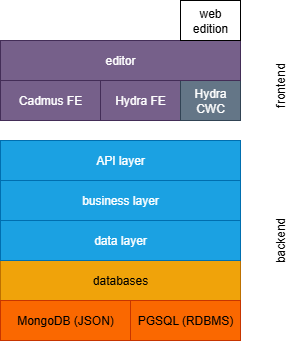
Starting from the bottom, data are stored in two types of databases: a document database (MongoDB, JSON-based) and a RDBMS (PostgreSQL). A data software layer anyway abstracts the details of these databases away from the rest of the stack: the data layer is the middleman between the underlying databases and any access to them from the upper layers. Then, a business software layer contains the core logic for the system. In turn, this is exposed to the external world via an API layer.
The software solution is designed for containerization and distributed in Docker images. So, it can be easily run off the shelf both in a web server and in a local machine, whatever its platform (Unix, MacOS, Windows). The most relevant images are:
- 🐋
vedph2020/cadmus-gve-api:latest: Cadmus-based editor API. - 🐋
vedph2020/cadmus-gve-app:latest: Cadmus-based editor frontend (web application). - 🐋
vedph2020/gve-demo: backend chain structure demo (web application). - 🐋
vedph2020/gve-api:latest: Hydra API.
Data produced by the editor can be represented with JSON data, or even plain text, and is stored in a standard document-based database (MongoDB), leveraging the power of the full-fledged Cadmus content creation framework, even if the model is completely independent from it.
Demo Pages
- core:
- rendition:
Editor
These pages are reserved to the VEdition team: